By Nick Man, CEO of CounselingSEO.com
The Truth About Your First 3 Months of Google Ads
Most group practice owners don’t start Google Ads because everything is calm. They start because the calendar feels unpredictable, referrals slow down, or their team has more openings than they’d like to admit.
And when the first week of ads doesn’t explode with consult requests, the mind goes into overdrive:
- “It’s not working.”
- “We’re wasting money.”
- “Maybe Google Ads just don’t work for therapy.”
Here’s what I tell every owner we partner with: You’re not watching a failing system. You’re watching a learning system.
Google Ads for counseling is not instant. It is patterned. Predictable. Built in phases. Once you know the rhythm, everything clicks into place.
Your first three months follow a clear arc. When you understand that arc, the entire experience becomes calmer, more strategic, and a lot less emotional.
Let’s break down exactly what happens.
Month 1: Google’s Learning Phase
This is the part no one warns you about. The first month is not designed to fill every clinician’s calendar. It’s designed to train Google’s algorithm so it can reliably bring in aligned clients.
Google doesn’t start by finding your ideal clients. It starts by learning who they are.
Before ads even run, there is setup work. Campaigns, tracking, landing pages, and conversion goals need to be built properly. This usually takes 7 to 14 days, especially if new landing pages are needed.
Once the ads go live, here’s what you can expect in the first 7 to 14 days:
- Search terms will look wide
- Clicks may feel random
- Cost per click fluctuates
- Data appears scattered
This is normal across every clinic we manage.
Our job in Month 1:
- Make sure analytics/tracking is setup (tracking integrations with services like janeapp)
- Check your ads often (daily for the first couple days)
- Make sure nothing is broken
- Avoid tweaking anything in the first 7–10 days unless it’s clearly broken
Any major adjustment resets the learning period and slows your path to predictable results.
Month 1 creates the foundation the system needs to stabilize.
The First Calls (Usually Weeks 2 to 3)
Most well structured campaigns begin seeing their first booked consults in the second or third week.
Sometimes earlier. Sometimes later. All are normal.
Each conversion teaches Google who is likely to convert again. This is where things begin tightening. Patterns form. The system becomes smarter.
After the first few conversions, you’ll notice:
- More accurate traffic
- Lower cost per click
- Lower cost per lead
- Clearer patterns
This is where confidence starts to rise and the early doubt fades.
Month 2: Stabilization
By Month 2, the system is no longer completely guessing.
Google now understands the behavior patterns of people who:
- Click your ads
- Book a consult
- Show up
- Become clients
The result:
- Targeting sharpens
- Lead quality improves
- Cost per acquisition becomes more predictable
- Inquiry patterns steady out
Month 2 is where the system begins to feel controlled instead of chaotic. This is where patience starts paying off.
Diagnosing Your Marketing (Without Breaking It)
If things aren’t where you expected, don’t scrap the system. Diagnose it.
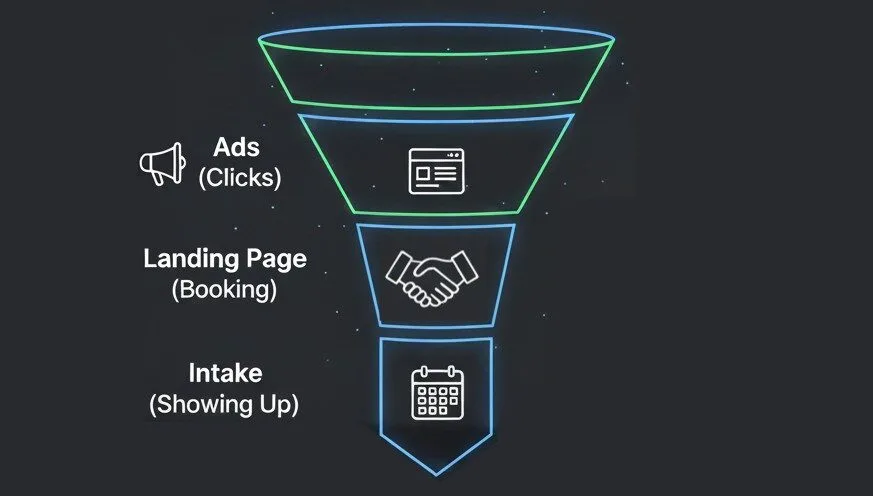
Here’s the simple funnel check:
- Are people clicking your ads? If not, fix the ads.
- Are people landing but not booking? Fix the landing page or website design.
- Are people booking but not showing up? Fix reminders or intake workflow.
- Are people showing up but not converting? Fix your 15-min consult script or onboarding process.
One broken step can drag down the whole system. But each step is easy to fix once you know where the drop off is.
Every campaign improves when each part of the funnel works together. The goal isn’t constant tinkering. The goal is steady refinement.
When the ads, the landing page, and the intake system are aligned, your cost per lead drops, your conversions rise, and the entire system becomes predictable.
Month 3: Predictable Lead Flow
This is the turning point.
By Month 3, Google has enough data to operate with real accuracy. Your ads stop feeling experimental and start feeling like a system.
You’ll see:
- Steady weekly inquiries
- Lower volatility in cost per lead
- Higher consistency in consult bookings
This is when owners start saying:
- “It’s suddenly working.”
- “We’re getting calls every week.”
- “This feels stable and calm.”
Month 3 gives you a clear sense of your long-term potential and how the system can scale as your team grows.
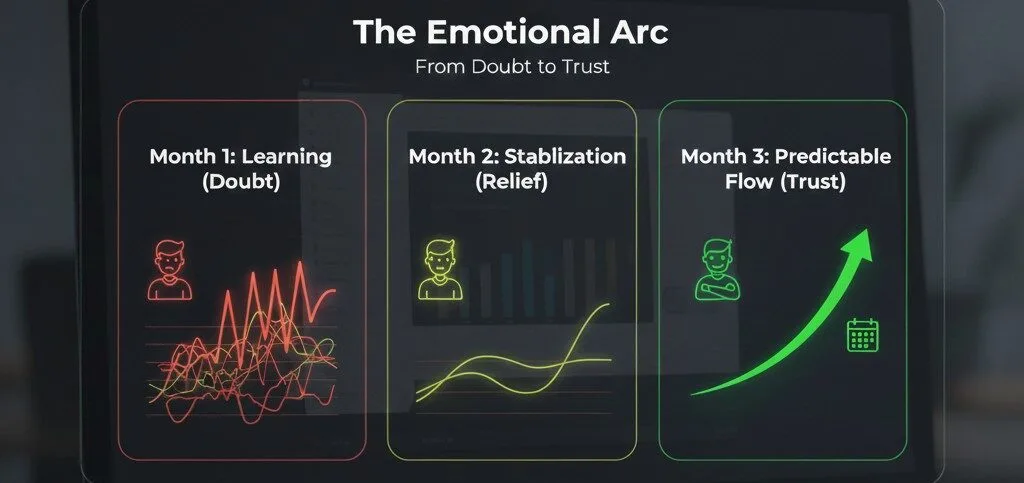
The Emotional Arc (Every Owner Experiences It)
Month 1: Doubt Month 2: Relief Month 3: Trust
You’re not just learning Google Ads. You’re learning predictability. Once you understand the timeline, the entire experience feels calmer and more grounded.
The Math That Makes This All Make Sense
Let’s make the numbers clear and calm.
If your clinic session rate is $160 per session and a client stays an average of 10 sessions, that’s:
10 x $160 = $1600 in total revenue
Now let’s account for the fee split. If your clinic keeps 40 percent, your take home from that client is:
$1600 x 0.40 = $640
This $640 is your Client Lifetime Value (LTV) under this example.
That means you could spend up to $640 to acquire that client and still break even.
If your Cost of Acquisition (CAC) is less than $640, you’re profitable.
Now look at the monthly investment:
- Spending $20 per day = $600 per month
- One new client at $160 per session often covers that entire spend
- Most clinics get more than one new client per month once stable
This is why Google Ads isn’t a gamble.
It’s math.
Therapy has a strong LTV to CAC ratio, which is why group practices scale so well once the system stabilizes.

When to Make Adjustments
If you’ve gone a full month with zero booked consults, that’s when you adjust.
Not panic. Not rebuild from scratch. Not shut it down.
Strategic adjustments:
- Improve ad copy
- Tighten your keywords
- Fix landing page friction
- Speed up intake response time
- Check technical issues
- Strengthen consult flow
Once the real bottleneck is identified, results improve quickly.
After Month 3: The System Runs Itself
By the time you hit month three you have a way better idea of the potential.
Most group practices communicate with us on a bi-weekly or monthly basis and we’re able to finetune the ads based on what’s actually going on in their clinic
Our aim is to design a system runs in the background while clinicians stay full.
The chaos disappears. The guessing stops. Your practice gains stability.
This is what paid acquisition is supposed to feel like.
The Bottom Line
Your first three months of Google Ads follow a clear arc:
- Month 1: Learning
- Month 2: Stabilizing
- Month 3: Predictable growth
Group practices that stay steady through the early turbulence end up with one of the most reliable engines for filling their clinicians’ caseloads.
If you want help reviewing your numbers, diagnosing your funnel, or building a system that scales predictably, let’s look at it together.
Book a free strategy session at CounselingSEO.com.
We’ll walk through your goals, your metrics, and the exact steps to create stable, predictable growth for your team.
Your focus should be on leading your practice and supporting your team.
Our job is to make your client acquisition predictable, steady, and aligned with how a modern group practice grows.

Nick Man is the founder of Counseling & Therapy SEO, where he helps therapists and counselors get more clients online without burning out on social media. With a background in SEO and conversion optimization, Nick builds calm, client-friendly websites and marketing systems that actually work.
You can find Nick on LinkedIn ↗.
Want to improve your rankings too? Check out how we help with SEO for therapists.
We also covered local SEO in our previous training — you can read the blog recap here.