The real question behind “Do we need SEO?”
You have looked at your numbers.
One clinician is full.
A few are close.
Others have stubborn gaps that never quite close.
You keep hearing the same advice in owner groups:
“You need SEO/GEO.”
“You should rank on Google Maps.”
“If you are not on page one, you are invisible.”
You are not afraid to invest.
You are afraid to waste 6 to 12 months on something you cannot evaluate.
The real questions in the back of your mind are:
- “Will SEO actually help fill my clinicians, or just produce pretty reports?”
- “How long will it take before we see real inquiries?”
- “What needs to be true inside our clinic before we spend a dollar?”
This article is here to answer those questions in plain language, so you can decide if SEO and local map work belong in your growth plan right now.
What SEO/GEO, Local SEO Map Rankings actually mean for a clinic
Let’s strip away the jargon and talk about what these terms really do for a counseling practice.
Cause here’s the Truth, good SEO for a counseling clinic covers three things at the same time:
- Showing up in Google search results
- Showing up in AI chat and AI powered search (GEO)
- Showing up in Google Maps with your Google Business Profile
These all aim to help the right people find your clinic and trust you enough to reach out.
So let’s define the terms and break it down so you can understand:
1. SEO | 2. GEO | 3. GBP Map Rankings
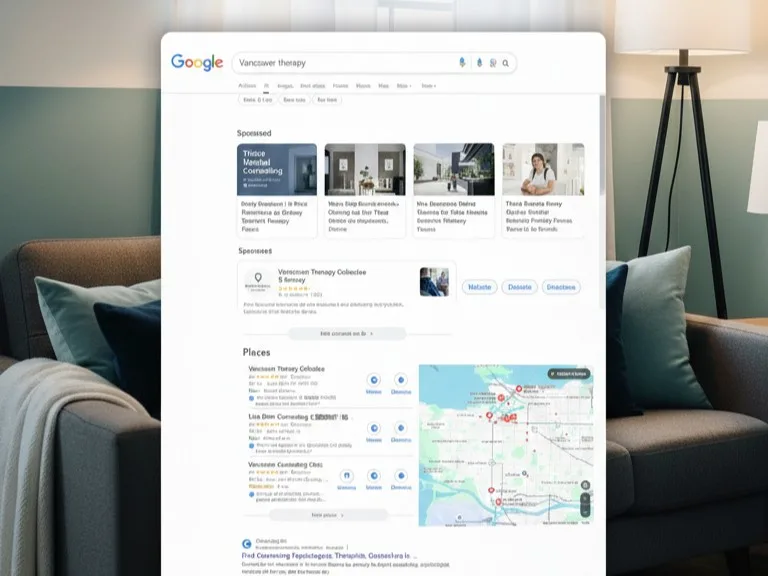
1. SEO: helping the right people find your website
Search engine optimization (SEO) is everything that helps your website show up when people type things like:
- “trauma therapist near me”
- “child counseling in [city]”
- “couples therapy [city]”
- “anxiety therapist for professionals”
If you’re showing up in the top 3 positions, there is a high likelihood that people will click and land on your website.
People love to overcomplicate SEO. You will hear you need to fix your:
- Schema
- Interlinking
- Blogging
- How fast and usable your site is
- Social media
All of that can matter, but it is really just different ways of doing two things.
SEO can basically be broken down into two components:
- On-page SEO
- Off-page SEO
This is where things get clearer.
On-page SEO is everything you do on your own website to tell Google what your clinic is about. In plain language, it is:
- Using the right keywords in the right places
- Making sure each page has a clear topic
- Helping Google and people quickly see who you help and what you offer
Off-page SEO is everything that helps Google see that other people think your site is worth paying attention to. That usually looks like:
- Other sites linking to your site
- Your practice being mentioned in local or professional directories
- Signals of credibility, authority, and trust around the web
So you can think of it like this:
- On page SEO tells Google “Here is what we do and who we serve.”
- Off page SEO is other sites telling Google “this clinic is legit and useful.”
Almost every SEO task you will ever hear about is really just serving one of those two jobs.
2. GEO: showing up in AI chat and AI powered search
GEO stands for Generative Engine Optimization.
It is the work that helps your clinic get mentioned when someone asks AI tools things like:
- “Find a couples therapist in [city] for high conflict relationships”
- “Who are some trauma therapists near me that see adults online”
- “What clinics in [city] specialize in child anxiety”
Generative engines like ChatGPT, Gemini, and others still have to decide:
- Which websites to trust
- Which clinics to mention
- Which information is current and relevant
They do not pull this out of thin air. They learn from:
- The content on your website
- How clearly you talk about your services and locations
- Signals of expertise and trust around the web
The good news is there is a big overlap:
Most of the work you do to improve SEO for Google search
also helps AI tools understand who you serve, where you work, and when it makes sense to suggest your clinic.
That means:
- Clear service pages
- Accurate local information
- Helpful content that actually answers the questions people ask
all help you show up both in Google results and in AI powered answers.
3. Google Business Profile (GBP) Map Rankings: showing up in the map section of Google
Local SEO is the location side of the story.
It tells Google:
- “We serve clients in these specific cities or areas”
- “We have offices at these addresses”
- “These are our main services in each place”
This is what helps you appear for searches like:
- “therapist near me”
- “counseling in [neighborhood]”
- “[city] couples therapy”
Local SEO is not a separate magic trick. It is SEO focused on geography.
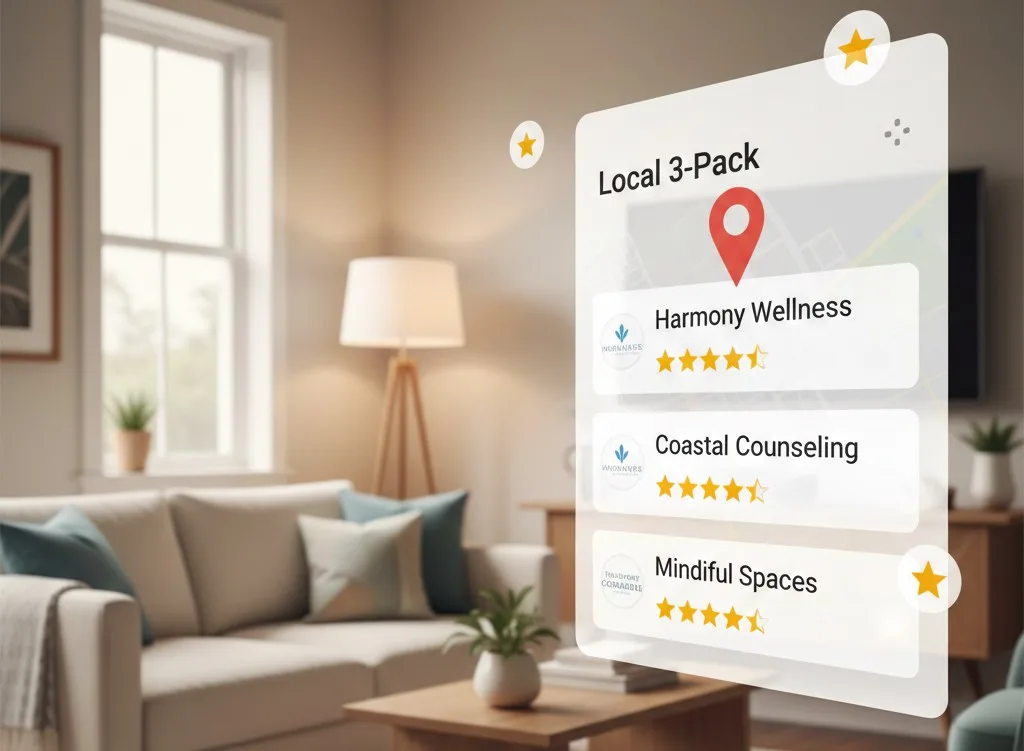
Map rankings: showing up in the local 3 pack
When someone searches “therapist near me,” they often see:
- A small map
- Three practices listed beside/underneath
This is called the local 3 pack.
Showing up there depends on things like:
- How close your office is to the person searching
- How relevant your listing is to their search term
- How established and consistent your presence is online
For many potential clients, that 3 pack is where they click first.
Done properly, your SEO, your GEO, and your GBP Optimization work all support each other:
- Your website
- Your Google Business Profile
- Your information across the web
are all part of one system.
Step one: Decide if SEO is even the right move right now
Before you ask “Which SEO package should we buy,” it helps to ask “Is SEO the right lever for our clinic this year.”
When SEO and local ranking are a strong fit
Your clinic is likely ready if:
- You have at least a modest monthly marketing budget
- You expect to stay in your current locations or states for several years
- Your clinicians have capacity for more clients
- You want to depend less on insurance panels and random referrals
- You have a clear intake process that makes the experience seamless
SEO is especially useful if:
- You are in a city where directories and competitors dominate page one
- You have multiple specialties you want to feature
- Your caseloads dip any time a single referral source dries up
In these cases, SEO can become a core driver of steady, qualified inquiries.
When SEO is probably too early or not the priority
SEO may not be the right first move if:
- You are still figuring out your niche, fees, or basic model
- You are planning to move offices or states in the next year
- Your website is so outdated or broken that it needs a rebuild first
- You are in genuine crisis mode and need new clients this month
- You need leads now and can’t afford to invest without immediate results
In those situations, you may be better off starting with:
- Quick win channels like Google Ads or select directories
- Clarifying your positioning and ideal clients
- Cleaning up your website and intake systems
SEO is more like building a flywheel than flipping a switch.
Once it gets going, it keeps helping you. But it takes time and consistency to get up to speed.
Step two: Get your foundations clear before you pay for SEO
Get your foundations clear before you pay for clicks or content.
SEO amplifies whatever is already true about your practice.
If your message is fuzzy, SEO makes that fuzziness more expensive.
If the intake process is not smooth, then you are just scaling chaos.
There are three foundations to check as a clinical director.
Know what you want to be found for
Google cannot prioritize “we treat everything.”
You need a clear priority list:
- Which services are most important to grow
- Which locations matter most
- Which populations or issues you want to be known for
For example:
- Priority 1: “anxiety therapy in [city]” for adults
- Priority 2: “couples counseling in [city]”
- Priority 3: “teen counseling in [city]”
This list becomes the spine of your SEO plan:
- Which pages you need
- Which terms to target
- How to structure your navigation
Without this, you risk ranking “a little bit for everything” and not filling anyone.
Make sure your website can turn visitors into clients
SEO sends more people to your website. That is all.
If your site is confusing, slow, or vague, more traffic just means more people bouncing off.
Before heavy SEO work, your site should:
- Load quickly on phones and computers
- Have clear, specific service pages for your key offerings
- Show your team in a human, approachable way
- Make it very easy to contact you or request an appointment
If 500 people from Google visit a well built site, some will become inquiries.
If 500 people visit a broken site, fewer will.
SEO works best when your team is ready.
Tighten your intake process so you can handle more inbound
There is no point driving more people to your clinic if:
- Calls go to voicemail and stay there
- Emails sit unanswered for days
- Your intake person has no clear way to match clients to clinicians
Intake does not have to be perfect. It has to be:
- Responsive
- Predictable
- Trackable
That means:
- Same day or next day replies when possible
- Clear rules for which clinician is the best fit for each case
- A simple way to note “found us on Google” when people call
Once these foundations are in place, SEO and local work can actually translate into fuller calendars, not just more noise.
Step three: Understand the basic SEO timeline and math
Clinical directors do not need an SEO certification.
You do need a simple mental model for what you are buying.
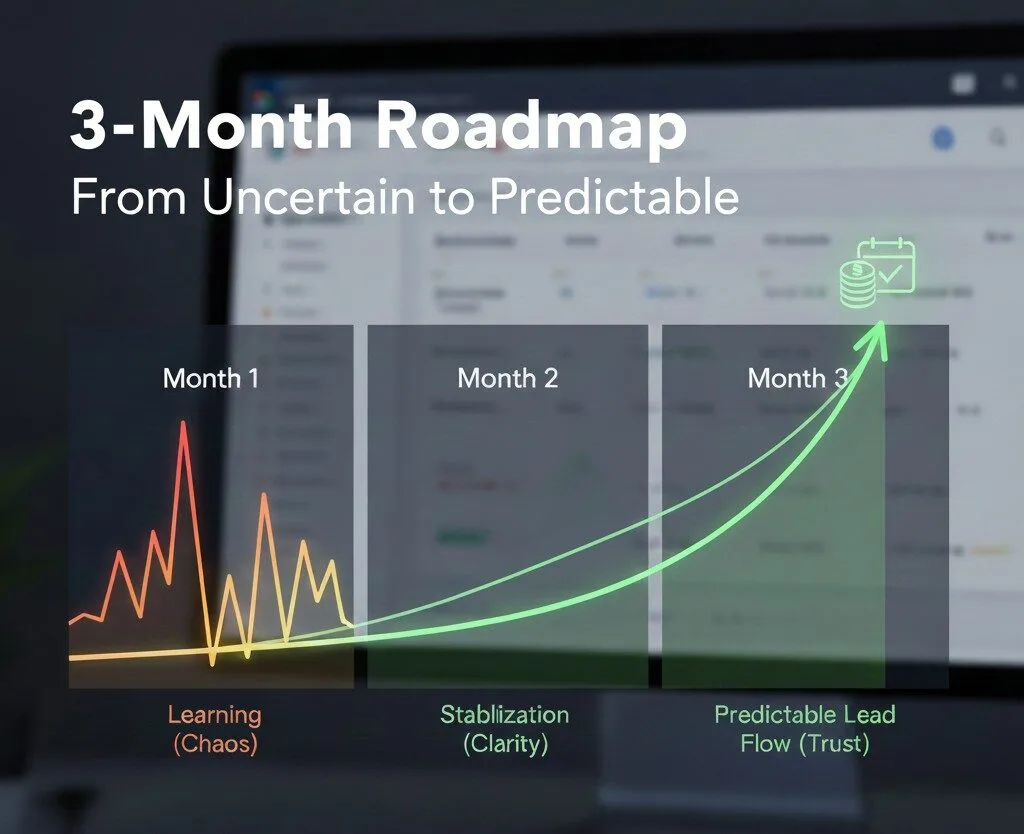
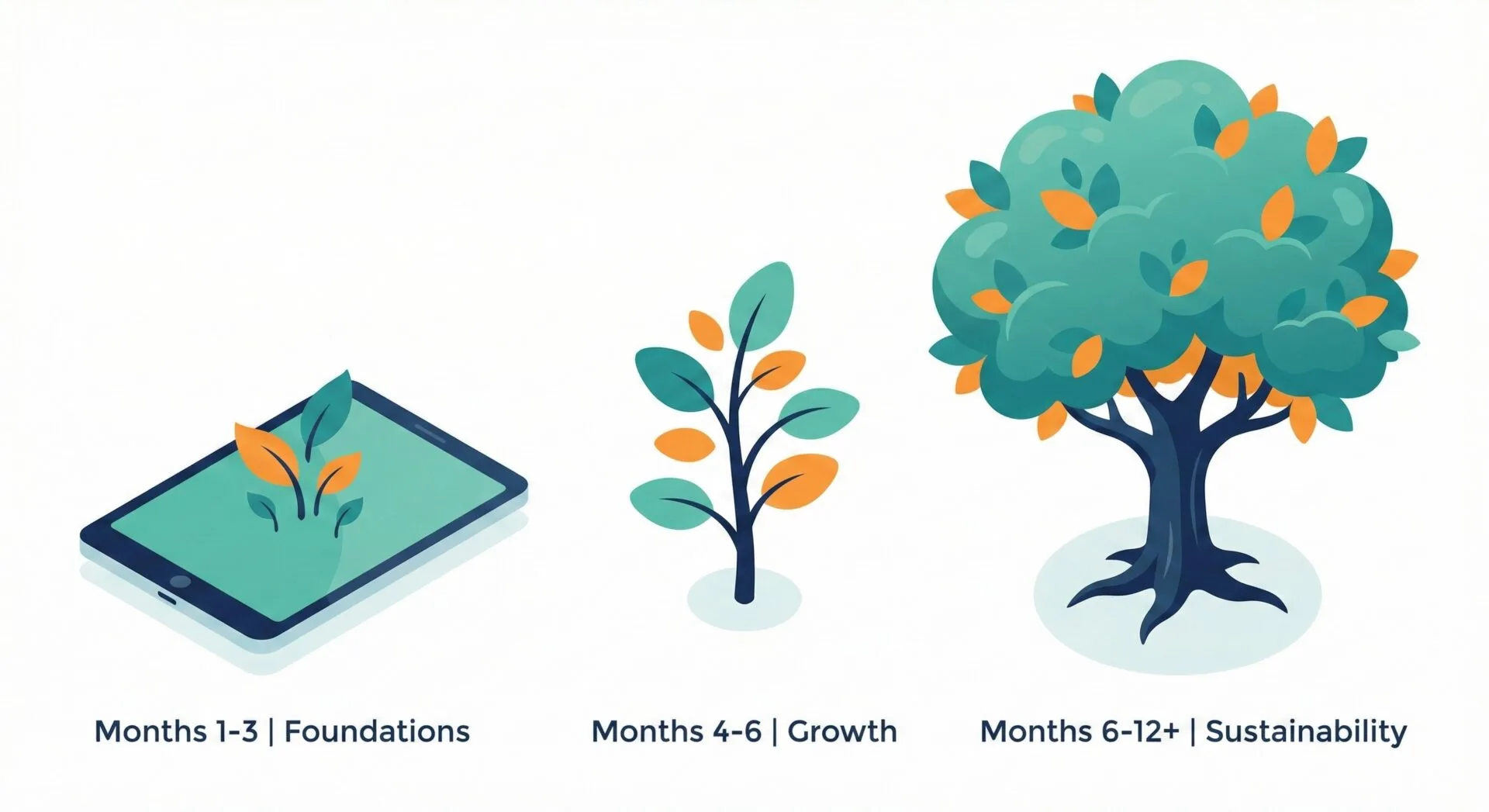
A realistic timeline for clinics
Every market is different, but a common pattern looks like this:
- Months 1 to 3
- Clean up your site structure and technical issues
- Clarify service and location pages
- Fix inconsistent information across the web
- Begin publishing targeted content
- Build out foundational links
- Months 4 to 6
- Priority pages climb toward page one for some searches
- Organic traffic and map views increase
- You start hearing “I found you on Google” more often
- Months 6 to 12
- More service and location pages rank
- A noticeable share of new intakes is coming from search and maps
- You rely less on paid ads and external directories
SEO is not instant, but it compounds.
The work you do in month 3 can still be paying off in month 18.
Simple 12 month math for SEO in a clinic
You can use the same thinking you would for ads.
Example:
- Average client stays for about 12 sessions
- Average fee is 150 dollars per session
12 sessions × 150 dollars = 1,800 dollars in revenue per new client
Now imagine you invest 1,200 dollars per month in SEO and local work.
Over a year, that is 14,400 dollars.
Ask:
- “By month 12, is it realistic that this work could be contributing at least 8 to 12 extra well matched clients a year?”
If even:
- 8 additional clients × 1,800 dollars = 14,400 dollars
You have broken even in direct revenue, and:
- Your site and rankings continue working beyond that year
- Your cost per organic client usually drops as rankings improve
If:
- 12 additional clients × 1,800 dollars = 21,600 dollars
You are well past break even, and that effect often grows as SEO matures.
These numbers will not be exact. The point is to see that:
- A modest lift in organic and map sourced clients can easily justify a thoughtful SEO investment over 12 months.
Step four: Understand local SEO and GBP map ranking work
When agencies say “we will get you on the map,” they are usually talking about a mix of:
- Optimizing your Google Business Profile
- Cleaning up your information across the web
- Strengthening the connection between your website and your map listing
Here is what matters most.
Your Google Business Profile
Your Google Business Profile is the box that shows:
- Your name
- Your address
- Your phone number
- Your hours
- A link to your website
It needs to be:
- Claimed and verified
- Using the right primary category (often “counselor” or similar based on your regulations)
- Filled out with services and a clear description
- Connected to your website with matching information
This is the anchor for local rankings and map visibility.
Consistent practice info (NAP) across the web
NAP stands for:
- Name
- Address
- Phone number
If your practice is listed as:
- Hope Counseling Center at one address with one phone number in one place
- Hope Counseling Group at a slightly different address and old number in another
it confuses Google.
Local SEO work often includes:
- Finding and fixing old or incorrect listings
- Making sure your name, address, and phone number are consistent anywhere they appear
- Updating major directories so they all tell the same story about your clinic
Consistency builds trust in Google’s system.
Reviews within ethical boundaries
Reviews are a strong local signal for most businesses.
For therapists, there are extra ethical and privacy layers. You should never:
- Pressure current clients to leave public reviews
- Offer incentives for positive reviews
- Respond in ways that confirm someone is a client
You can:
- Make it easy for people who already want to leave public feedback to do so
- Use general language in responses that protects confidentiality
- Focus on strengthening your broader reputation through content, speaking, and community involvement
Any SEO partner you work with should understand and respect these boundaries.
Proximity, relevance, and prominence
Google Maps looks mainly at:
- Proximity
- How close your office is to the searcher
- Relevance
- How well your profile, categories, and content match the search
- Prominence
- How established and trustworthy you appear online
You cannot move your building closer to every searcher.
You can strengthen relevance and prominence through:
- Clear practice details
- Good on site content about your services and location
- Clean, consistent listings around the web
That is what GBP Map ranking work really is: making it very clear who you help and where you help them, in language both people and Google understand.
Step five: Choosing the right SEO partner and knowing what to watch
Many clinical directors are not burned by SEO itself. They are burned by SEO vendors.
Here is how to protect your clinic.
What a good partner should do
A solid SEO partner for counseling clinics will:
- Ask detailed questions about your services, locations, and capacity
- Help you prioritize which services and cities to focus on first
- Explain their plan in plain language
- Show you which pages they are working on and why
They will talk about:
- Calls, forms, and booked clients
more than just “traffic” and “impressions.”
Red flags to watch for
Be cautious if you hear:
- “We guarantee number one rankings in 30 days.”
- “We own your website and content. If you leave, you lose everything.”
- “We cannot share our methods. They are proprietary.”
- “We will get you hundreds of reviews fast.”
Also be wary of:
- Long contracts with no mutual exit plan
- Reports that only show vanity metrics like impressions or “visibility scores”
- A generic approach that sounds like it could apply to any dentist, plumber, or roofer
As a clinical director, you need a partner who understands healthcare and counseling, not just “local businesses.”
A simple way to track whether SEO is working
You do not need complex dashboards. Start with:
- Asking “How did you find us?” on intake
- Tracking how many people say “Google search” or “I saw you on Maps”
- Looking at organic traffic and map actions (calls, website clicks) every quarter
At least every few months, you should be able to answer:
- Are more people finding us through search than six months ago
- Are we getting more inquiries that clearly came from Google
- Are those inquiries becoming good fit clients for our clinicians
If the answer is “yes,” SEO is doing its job.
How SEO strategy shifts when you have multiple clinicians or locations
For a solo therapist, SEO can be simple.
For a clinic, you have more moving parts.
Multiple clinicians and specialties
You might have:
- Trauma specialists
- Couples therapists
- Child and family clinicians
- EMDR, OCD, or perinatal specialists
Your SEO plan needs to:
- Decide which services get top billing
- Group related services logically on the site
- Use internal links to help Google understand how your services connect
You do not need a page for every micro niche on day one.
You do need a clear structure that can grow with your team.
Multiple offices or telehealth states
If you have more than one office or serve multiple states via telehealth, your strategy should include:
- Location specific pages that talk about services in each city or neighborhood
- State specific telehealth pages where appropriate
- Separate Google Business Profiles for distinct physical locations
This allows you to:
- Target searches like “therapist in [city A]” and “therapist in [city B]” separately
- Balance growth across locations
- Avoid one office being overwhelmed while another sits underused
A good SEO and local plan will respect your real world structure, not force you into a one size fits all template.
What success with SEO and maps feels like for a clinical director
When SEO and local work start to click, it does not feel like fireworks. It feels like:
- “We are not panicking about referrals every quarter.”
- “New clients keep saying they found us on Google.”
- “We can be a bit more selective and match people to the best clinician.”
- “We are less dependent on insurance panels and one or two referral partners.”
You might notice:
- Calendars filling more evenly across your team
- Slightly less pressure to constantly run high ad budgets
- A baseline of inquiries even in slower seasons
In other words, a more predictable, sustainable practice.
A calm next step if you are considering SEO and GEO
If you are reading this as a clinical director, you are already carrying a lot:
- Client care
- Team support
- Hiring and retention
- Finances
- Your own life and bandwidth
You do not need another confusing project.
You need clarity:
- Is SEO and local map work the right lever for my clinic this year
- Staying ahead of the curve and having your clinic suggested in chatGPT, Gemini etc.
- If yes, what needs to be fixed first so it actually pays off
- How would we measure success at 6 and 12 months
That is where we come in.
At CounselingSEO, we work only with therapists, group practices, and counseling clinics.
If you want a clear picture before you invest, you are welcome to schedule a strategy conversation.
In that call, we can:
- Look at your current website, locations, and team
- Talk through your goals and where you feel stuck
- Map out what a realistic SEO and local plan would look like for your clinic
- Walk through the simple math so you can see what “good” would mean in your situation
From there, you can decide to:
- Invest in SEO/GEO and Map Ranking now
- Start with smaller foundational work
- Or wait, with a clear checklist of what needs to be true before this is your next move
No pressure. Just a grounded conversation, so you can lead your clinic’s growth with confidence instead of guessing.

Nick Man is the founder of Counseling & Therapy SEO, where he helps therapists and counselors get found on Google without compromising their values (or burning out on social media). With a background in SEO and marketing, Nick builds calm, conversion-friendly websites and SEO strategies that actually feel human.
You can find Nick on LinkedIn  .
.